Author Pages and Google E-E-A-T in 2026: What Actually Works for Trade Businesses

Published October 31, 2026
E-E-A-T is Google's name for experience, expertise, authoritativeness and trust, and Google says trust is the most important of the four. For a trade business it comes down to proof a stranger can check. A named owner, a license number, real job photos, reviews labeled with where they came from, and an author page that ties it together. The September 2026 spam update showed us what happens when a site fakes any of it. Two of our own directories, built and then left sitting, lost more than 90% of their Google traffic. In the same months our auto sites, run by real mechanics with real jobs behind every page, kept growing. Below is what both taught us, what we fixed, and a checklist you can run today.
What E-E-A-T Is, in Google's Own Words
We audit a lot of trade sites. Mechanics, locksmiths, roofers, bail agents, private investigators. Almost every owner has heard of E-E-A-T. Almost none have read what Google actually wrote about it. So start there.
The letters come from Google's Search Quality Rater Guidelines, the handbook Google gives the people it pays to check search results. The current version is dated September 11, 2025. Google added the first E, for Experience, in December 2022.
- Experience. You did the work yourself. You replaced the timing chain. You rekeyed the lock. You walked the roof.
- Expertise. You know the trade. Training, licenses, years on the job.
- Authoritativeness. Other people point to you. Customers, suppliers, your state board, the local paper.
- Trust. The page is accurate, honest and safe. The rater guidelines put trust at the center and say an untrustworthy page has low E-E-A-T no matter how expert it looks.
Google's helpful content documentation says plainly that E-E-A-T itself is not a specific ranking factor. Its systems use a mix of signals that line up with it. Raters do not move your rankings either. Google uses their grades to check whether its systems are working (Danny Sullivan said so in 2024).
So you cannot install E-E-A-T. You can only show it. John Mueller put it bluntly at Search Central Live in 2025: you can't sprinkle experiences on your pages. The proof has to be real.
Why It Matters More After the September 2026 Spam Update
Google's September 2026 spam update started September 24 and finished October 8, 13 days and 16 hours by Google's own status dashboard. Google did not say what it went after. Its documentation describes spam updates as improvements to automated spam detection, and its spam policies say sites that break them may rank lower or drop out of results.
I can tell you what it went after on our sites, because it hit two of them.
Our locksmith directory was doing about 1,000 Google impressions a day. On September 27 it did about 25. Even searches for a listed business by its exact name stopped showing us. Our roofing directory fell more than 90% a few days later. Both sites stayed indexed. Neither had a manual action. They were demoted, not removed.
In the same weeks, our sites built around real named people, like our mechanic directory built around named mechanics and real reviews, held up or grew. Same company, same hosting, same writers. The difference was what the pages claimed and who stood behind them.
Here is the part I have to own. Both directories were built and then left lying dormant. No owner working them, no fresh content, nothing new from the real world. The sites we worked every week kept growing. Dormant was not the only cause, but it sat right next to the three below. E-E-A-T is not a one-time setup.
We went through both sites line by line. Three patterns stood out, and every one of them is a trust problem in Google's own documents.
Mistake One: Badges We Gave Ourselves
Both directories gave listed businesses a "certified" or award badge, with a public verify page for each one and an embed code that linked back to us. We built it to help owners show off. At scale it looked like something else.
Thousands of near-identical verify pages, each one a badge we awarded with no outside check. Google's spam policies cover scaled content abuse, many pages made mainly to manipulate rankings, and link spam. The rater guidelines tell raters to look at what others say about a site, not only at what it says about itself.
What we did. All 20,658 verify pages across the two sites now redirect to the listing or carry noindex and are out of the sitemaps. Badge embeds are nofollow. Badges only show on listings where the owner claimed the page and opted in.
The lesson for your own site. A badge you made for yourself is not proof. A license number a customer can look up on your state board is.
Mistake Two: Google Ratings Copied Into Our Schema
Each listing showed the business's Google star rating, which is fine. We also put that rating into AggregateRating schema, so it could show stars in search. That is not fine.
Google's review snippet documentation says not to aggregate reviews or ratings from other websites, and that ratings must come straight from users on your own site. It also says reviews a business controls about itself are not eligible for star results.
What we did. AggregateRating now comes only from reviews left on our own sites. The Google rating still shows on the page, labeled as Google's, with the review count and a link to the Google profile.
The lesson. If you run a trade site, do not paste your Google rating into review schema. Show it, credit Google, link to it. Collect your own reviews if you want stars in your markup.
Mistake Three: Thin Pages on One Template
The locksmith directory had 9,814 listings. Most had the same paragraph with a name and city swapped in. Some had no phone number, no hours and no owner. Multiply that by city pages and you have what Google's spam policies describe under scaled content abuse and doorway pages, which include pages aimed at cities that all funnel to the same place.
Google's helpful content page asks it as a self-check. Are you using extensive automation to produce content on many topics?
What we did. 4,488 thin listings across the two sites are now noindex. A listing earns its way back by having something real on it, such as a phone, hours, an owner, our own reviews, or facts pulled from the business's own website. On the locksmith site, page dates now change only when that page's own content changes, not when we touch the template.
The lesson for a trade business. Fifty city pages that say the same thing will not help you. One strong service page with your real jobs in those cities will.
We will post the recovery numbers when Google has had time to recrawl. Spam updates are not instant in either direction.
What Worked: Our Auto Sites Grew With Real People Behind Them
Now the other side. While two dormant directories fell, the auto sites we work every day grew, and they are built the opposite way.
- Real mechanic bylines. Posts are signed by people who do the work. Mine reads "ASE Business Built With Master Automotive Technicians," because the shop is the certified part, not me personally.
- Owner author pages. Every byline links to a page with a real photo, the shop, and profiles you can check.
- Real job photos. From Supercanic jobs, not stock.
- Real paid-job prices. Our mobile mechanic prices study on MechanicRank is built from 953 paid Supercanic invoices, median $218, published as aggregates only.
- Real mechanics on camera. We interviewed working mobile mechanics, published their videos and wrote from what they said.
The numbers, with where each one comes from.
- PrePurchaseAuto went from 2 Google clicks to 2,672 in eight weeks (Search Console, Jun 29 to Aug 24 vs Aug 25 to Oct 20, 2026), and from 4 paid inspections ($775) to 55 ($13,375 gross) in the same windows (Shop Desk).
- MechanicRank went from 1,048 sessions in the first 24 days of GA4 tracking (Aug 1 to 24, 2026) to 9,943 in the 24 days ending Oct 20, with scraper traffic from Singapore taken out, and AI assistant visits went from 28 to 249 (GA4). It logged 2,723 key events in two weeks, 1,932 of them taps on a call button (GA4, two weeks ending Oct 20).
- Supercanic tracked calls went from 529 a month in October 2025 to 1,328 in September 2026 (CallRail).
I wrote up the whole PrePurchaseAuto and MechanicRank story as a case study for DataForSEO: How DataForSEO Helped Monetize Our Newest Auto Site.
I cannot split out how much of that came from E-E-A-T alone. Data, speed and a lot of pages helped too. But the pattern is hard to miss. Same company, same writers. The sites with active, owner-led, real expertise grew. The ones built and left with templated pages and borrowed ratings got hit.
What Real Expertise Looks Like for a Trade Business
Here is the good news. Trade owners already have more real E-E-A-T than most publishers. It just never makes it onto the website. These are the signals that count, worst gap first, from what we see in audits.
- A named owner with a real photo. Not "our team." Not a stock photo. Your face, your name, your role. The rater guidelines tell raters to start with the About page or the creator's profile page.
- A license a customer can check. Put the number on the page and link the lookup. California contractors can be checked on the CSLB license search, auto repair shops through the Bureau of Automotive Repair. Every state has its own.
- Real job photos. From your phone, from the job, with the before and the after. Google's self-assessment asks whether content shows first-hand expertise and gives original information. A stock photo of a smiling roofer does neither.
- Your numbers. What a brake job really costs you to do in your town. How long a rekey takes. How many roofs you did last year. Original information is on Google's list for a reason.
- Reviews labeled by source. Google rating from Google, with a link. Yelp from Yelp. Your own reviews from your own form.
- A byline on every guide. Google strongly encourages accurate authorship information and asks whether pages carry a byline where one might be expected. A how-to post should. A plain service page can be signed by the business.
- An author page that ties it together. One page per person, linked from every byline. That is the next section.
Anatomy of a Real Author Page
Here is mine on EEAT Authors, so you can see every part.
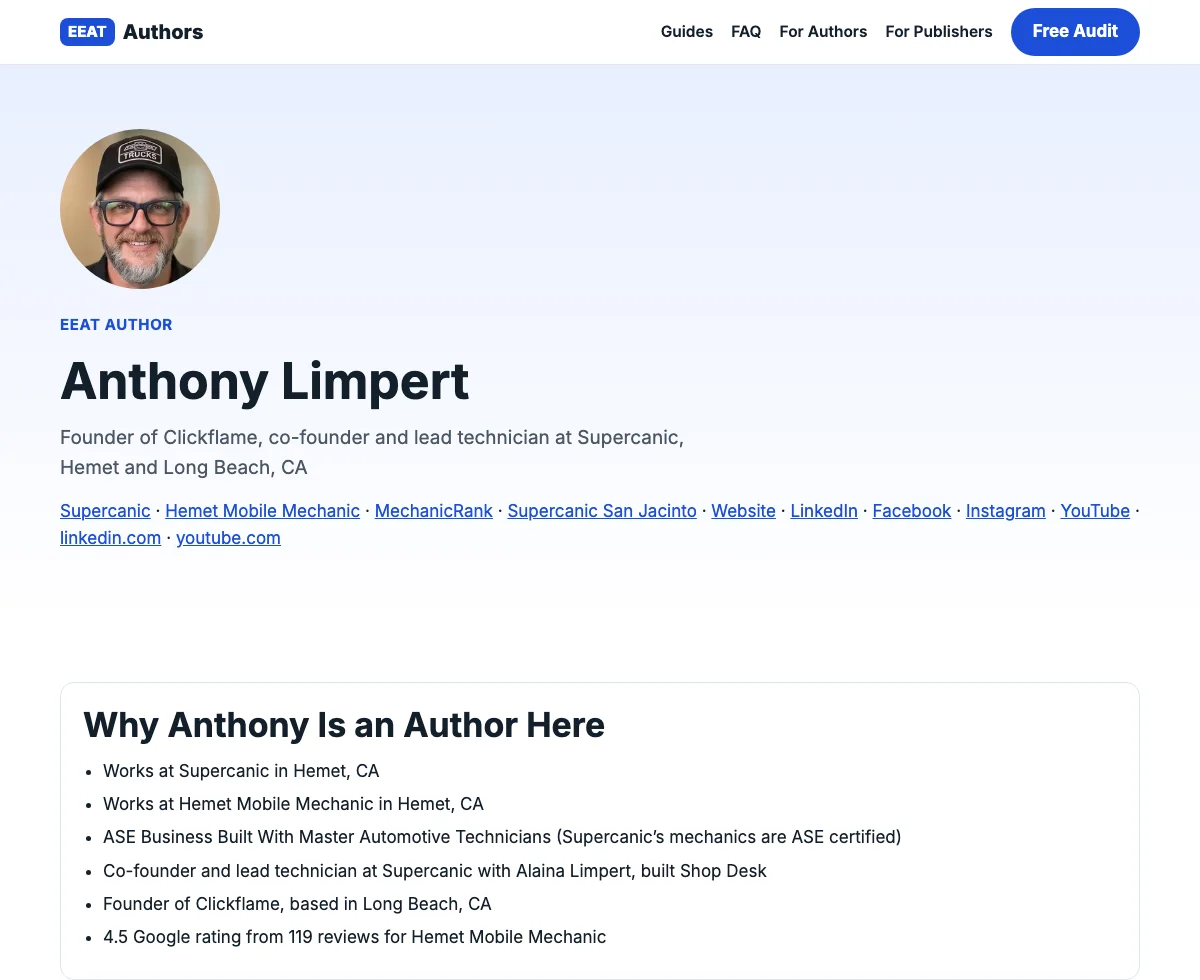
- Real photo. That is me in a Supercanic shirt. Not a suit, not a stock image.
- Full name and current role. Founder of Clickflame, co-founder and lead technician at Supercanic, with the cities.
- Links you can check. The shop sites, MechanicRank, LinkedIn, Facebook, Instagram, YouTube. These also go in the page's sameAs markup.
- Why this person is an author here. A short box with the strongest proof first, including a review line credited to Google with the count.
- Proof laid out by E-E-A-T. Experience, Expertise, Authoritativeness and Trust each get their own list, and each line links to its source where one exists.
- Markup. ProfilePage with a Person inside, the way Google's ProfilePage docs describe it, and every post's Article markup points its author url at this page, per Google's author markup best practices.
The copy-ready markup is in our author schema guide and the bio wording is in the author bio guide.
See the whole page at eeatauthors.com/authors/anthony-limpert/.
Your EEAT Score: What the EEAT Authors Audit Checks
Google does not hand your site an official E-E-A-T number. That is exactly why a practical score helps. It turns Google's own guidelines into a checklist you can measure and fix.
The EEAT Authors score reads up to 8 public pages from your site (home, one post, About, Contact, an author page, robots.txt and llms.txt) and scores 14 trust signals out of 100. Author signals carry 34 of the points, because they are the fastest to fix and the most often missing.
| Check | Points | What it looks for |
|---|---|---|
| Named author on your posts | 12 | A real person named on each post, in the page and in its markup |
| Author pages | 8 | A page for that person that says who they are and what they have done |
| Person schema with credentials | 8 | Person markup that lists credentials, job title and employer |
| Real customer reviews | 8 | Reviews from real customers, labeled with where they came from |
| Sources cited in posts | 8 | Links out to the sources behind the claims in a post |
| About page | 7 | An About page with enough real detail to judge the business |
| Contact page | 7 | Phone, email and a physical address a customer can use |
| Published and updated dates | 7 | When a post went up and when it was last checked |
| Business schema | 7 | Organization or LocalBusiness markup with address and phone |
| sameAs profile links | 6 | Links from the author to profiles anyone can check |
| Licenses and credentials shown | 6 | A license, certification or credential visible on the page |
| AI search can read your site | 6 | A robots.txt that lets the main AI search crawlers read the site |
| llms.txt for AI tools | 5 | A plain file that tells AI tools what the site is |
| HTTPS and privacy policy | 5 | HTTPS on every page and a privacy policy link |
Here is a real one. My own shop's site, supercanic.com, run on October 31, 2026.
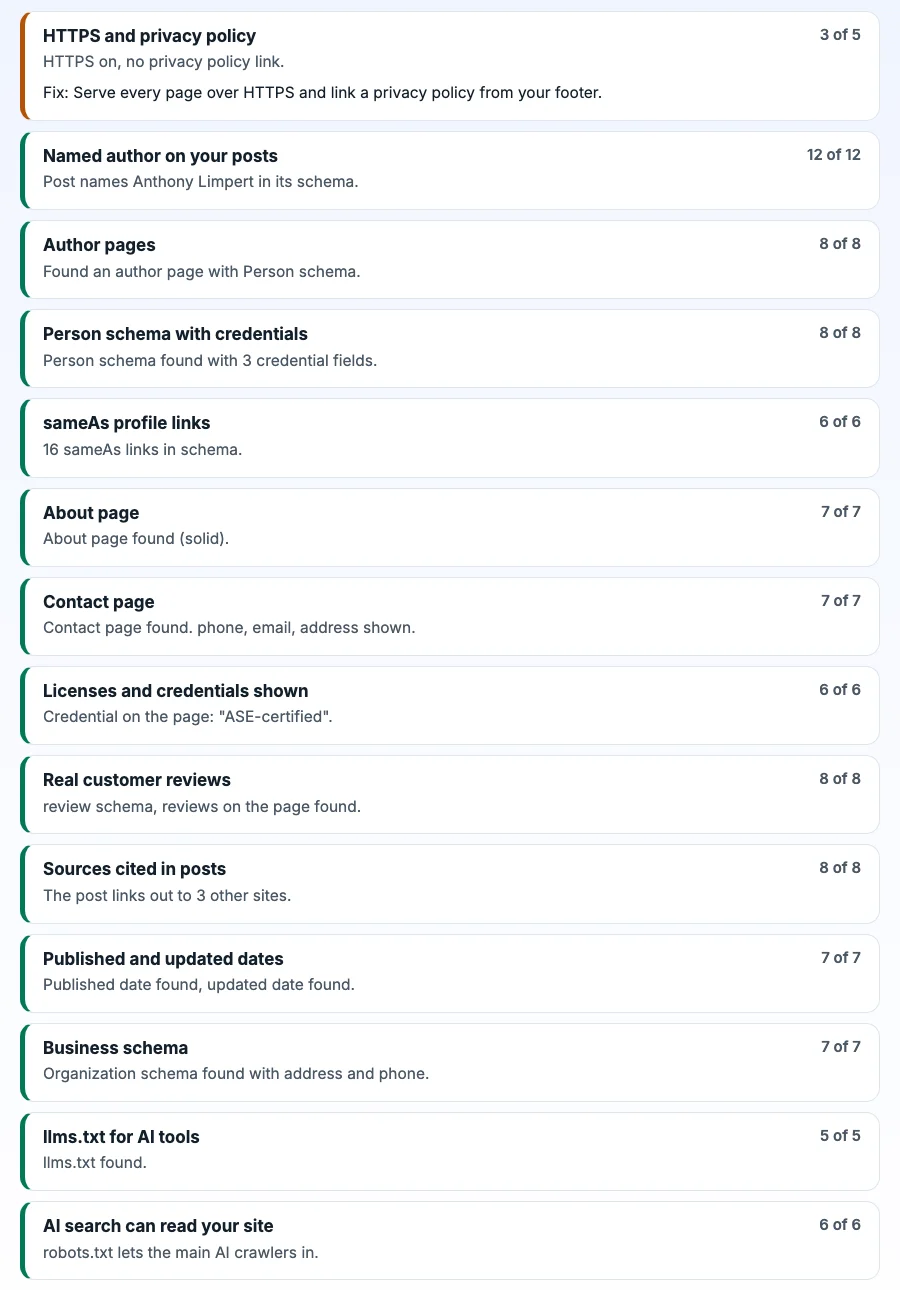
98 of 100, with one fix. That is not luck. It is the same checklist below, done one page at a time.
The 2026 E-E-A-T Checklist for Trade Businesses
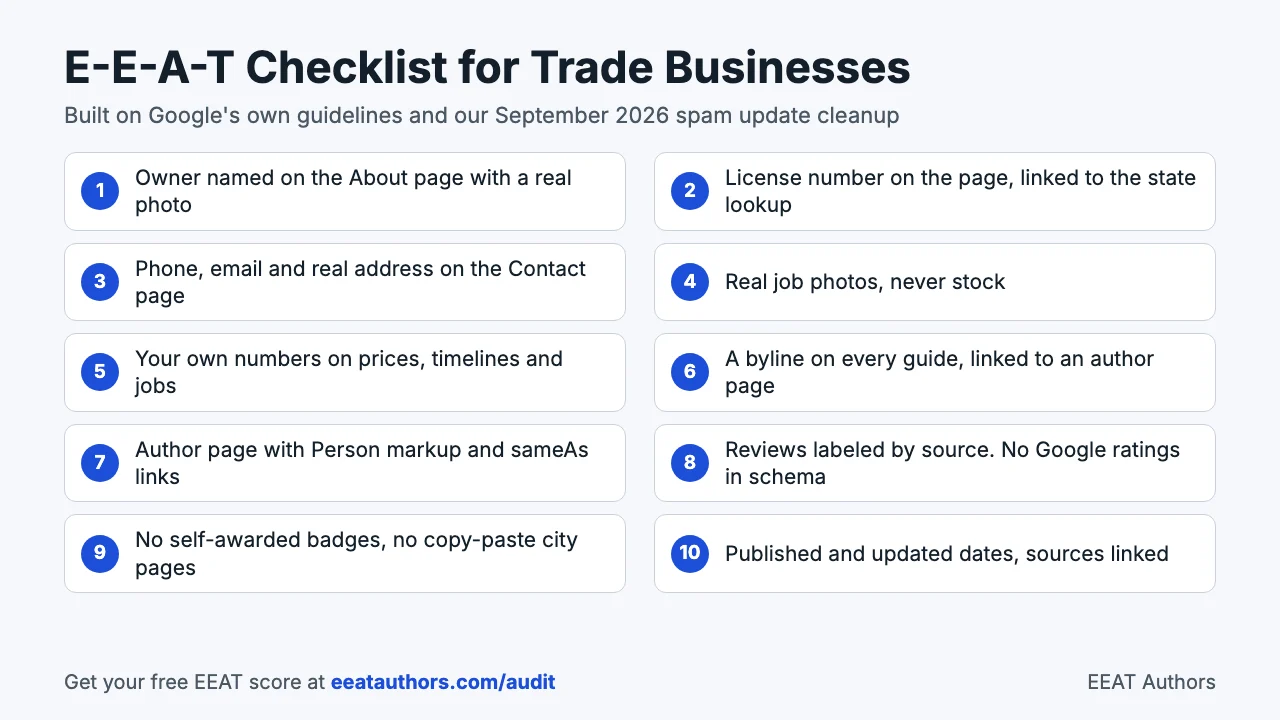
- Owner named on the About page with a real photo
- License or certification number on the page, linked to the state lookup
- Phone, email and real address on the Contact page
- Real job photos on service pages and posts, never stock
- Your own numbers on prices, timelines and jobs done
- A byline on every guide and post, linked to an author page
- An author page with Person markup and sameAs links
- Reviews labeled by source, with links. No Google ratings in your review schema
- No self-awarded badges and no copy-paste city pages
- Published and updated dates, and sources linked in posts
Get a Free Expert Author Page on EEAT Authors
We built EEAT Authors because most trade owners have the experience and none of the pages to prove it.
If you are a licensed or experienced pro, you can join as an author for free. No payment, ever. We check that you are a real person with a real credential, then build your author page with your photo, your credentials, your review lines credited to their source and links to your business. Your name goes on posts in your field across our sites and our customers' sites, and you can list any topics you do not want to write about.
If you own a site and want vetted experts reviewing or writing your posts, see the plans.
Either way, start with the free score. It takes about 20 seconds.
Sources
- Google Search Central, Creating helpful, reliable, people-first content
- Google Search Quality Rater Guidelines, September 11, 2025
- Google Search Central, Spam policies for Google web search
- Google Search Central, Review snippet structured data
- Google Search Central, Article structured data
- Google Search Central, ProfilePage structured data
- Google Search Central, Using generative AI content
- Google Search Status Dashboard, September 2026 spam update
- Google Search Central Blog, E-A-T gets an extra E for Experience, December 2022
- Search Engine Roundtable, Google on E-E-A-T and quality raters, 2024
- Search Engine Journal, You cannot add E-E-A-T to your pages, 2025
- Search Engine Journal, September 2026 spam update complete
- Anthony Limpert on the DataForSEO blog, How DataForSEO Helped Monetize Our Newest Auto Site, October 2026
- MechanicRank, Mobile mechanic prices from 953 paid jobs
- Our own Google Search Console, GA4, Shop Desk and CallRail data, 2025 and 2026
Questions People Ask
What does E-E-A-T stand for?
Experience, Expertise, Authoritativeness and Trust. The terms come from Google's Search Quality Rater Guidelines, and trust sits at the center.
Is E-E-A-T a Google ranking factor?
Not by itself. Google says E-E-A-T is not a specific ranking factor, but its systems use many signals that line up with it, so showing it still matters.
What are the E-E-A-T principles of Google?
Show first-hand experience, real expertise, a reputation others confirm, and above all trust: accurate, honest, safe pages with a clear person or business behind them.
Does Google give my site an E-E-A-T score?
Google does not publish an E-E-A-T number for sites. The EEAT Authors score is a practical checklist score built on Google's own guidelines, so you can measure the signals and fix the gaps.
How do I check my site's E-E-A-T?
Run the free EEAT Authors audit. It reads up to 8 public pages and scores 14 trust signals out of 100, with a fix for each gap.
Do author pages help SEO?
Google strongly encourages accurate authorship information and asks whether pages have bylines. An author page gives readers and raters a way to check the person behind a byline.
Does a trade business need author bylines?
On guides and how-to posts, yes. Google asks whether pages carry a byline where one might be expected. A plain service page can be credited to the business.
Can I put my Google reviews in review schema?
No. Google's review snippet rules say not to aggregate ratings from other websites. Show your Google rating on the page with a link and credit, and use only your own collected reviews in markup.
What was the September 2026 spam update?
A Google spam update that ran from September 24 to October 8, 2026. Google did not say what it targeted. Sites that break its spam policies can rank lower or drop out of results.
Does AI content hurt E-E-A-T?
Not for being AI. Google says AI can help make good content, but it must be fact-checked by a person, and made-up author profiles are rated lowest in the rater guidelines.
Does E-E-A-T need ongoing work?
Yes. It is not a one-time setup. The sites we built and left dormant were hit by the September 2026 spam update, while the sites we kept working with real owners, jobs and data kept growing.
How do I get a free expert author page?
Licensed and experienced pros can join EEAT Authors free at eeatauthors.com/become-an-author. We check you are real, then build your author page.
Check Your Own Site
Our free audit reads your site and scores 14 trust signals out of 100, with a fix for each gap. No signup.
Where to Find Us
235 E Broadway #800, Long Beach, CA 90802