Does Google Penalize AI Content? The Fake Author Problem

Published October 30, 2026
No, not for being AI. Google says generative AI can make good or bad content. What its rater guidelines do put on the lowest list is AI content with made-up authors, and profiles that claim credentials the person does not have. The AI is not the problem. The fake person is.
What Google Actually Says About AI
Google's guidance on generative AI is short and calm. AI can help make high quality content. It is critical to fact-check AI content by hand before publishing, including titles, meta descriptions and structured data. Telling readers how a page was made gives them useful context.
The rater guidelines say the same thing from the other side: generative AI tools can be used for high quality and low quality content. The tool is neutral. The effort is what gets graded.
Where AI Content Does Get Hit
Two places.
Scaled content abuse. Google's spam policies cover publishing lots of pages mainly to game rankings, and AI is one of the named ways people do it. A thousand city pages with the city name swapped is the classic case.
Little to no effort. The guidelines rate pages lowest when the main content is copied, paraphrased or generated with little effort, little originality and no added value.
Neither one is about AI. Both are about pages nobody stands behind.
The Fake Author Problem
Here is the line most AI content guides leave out. Section 4.5.2 of the guidelines lists, under the lowest rating:
- Sites with fake owner or author profiles, with AI content and made-up author profiles given as an example.
- Author profiles that falsely claim credentials or expertise, like claiming to be a medical professional.
It is a pattern we see often when we audit sites. A blog full of AI posts, each signed by a smiling stock photo with a name nobody can find anywhere else. Sometimes the bio even claims a nursing degree.
A reader who Googles that name finds nothing. A rater finds nothing. That is a trust failure on every post on the site, and it is fully avoidable.
What We Find When We Check Bylines
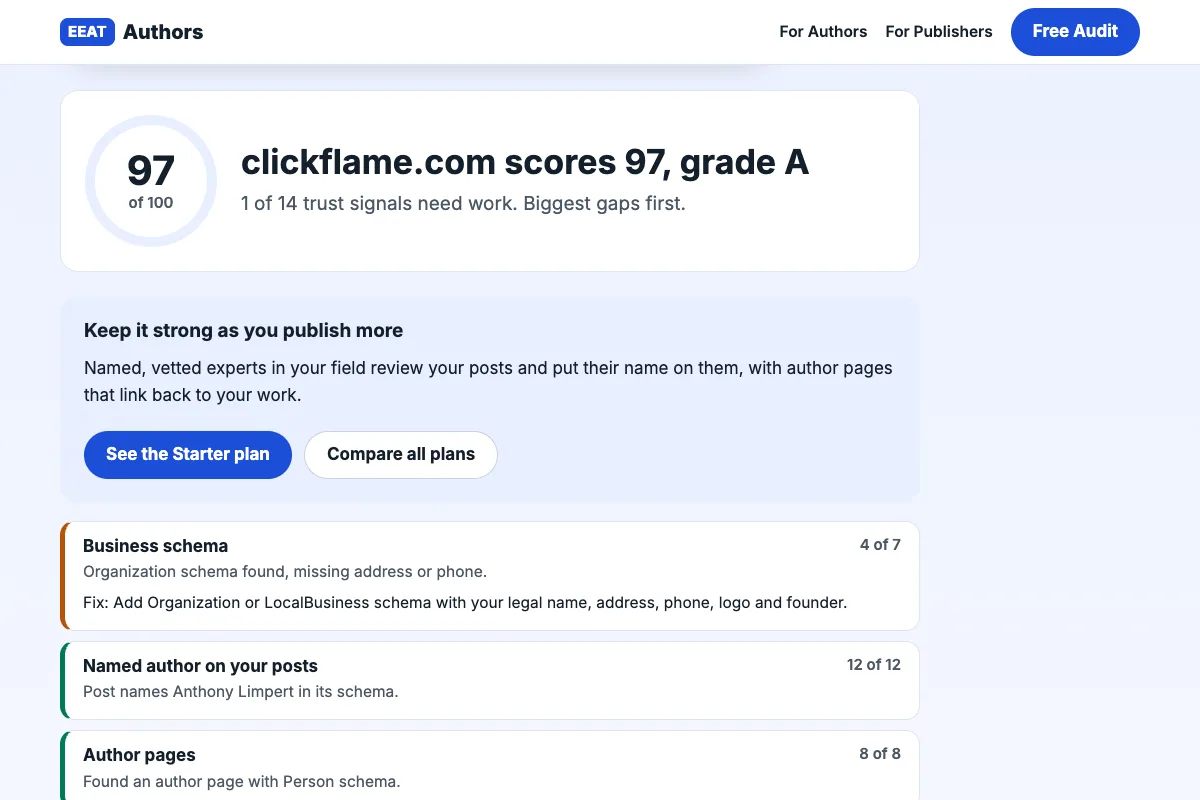
Our free audit scores 14 trust signals. The four author checks, a named byline, an author page, Person schema with credentials and sameAs links, carry 34 of the 100 points. They are also the four a site owner can fix fastest, because the expertise usually already exists inside the business. It just never made it onto the page.
Real Author, Honest Byline
The fix is not to stop using AI. It is to put a real person behind each page and label what they did.
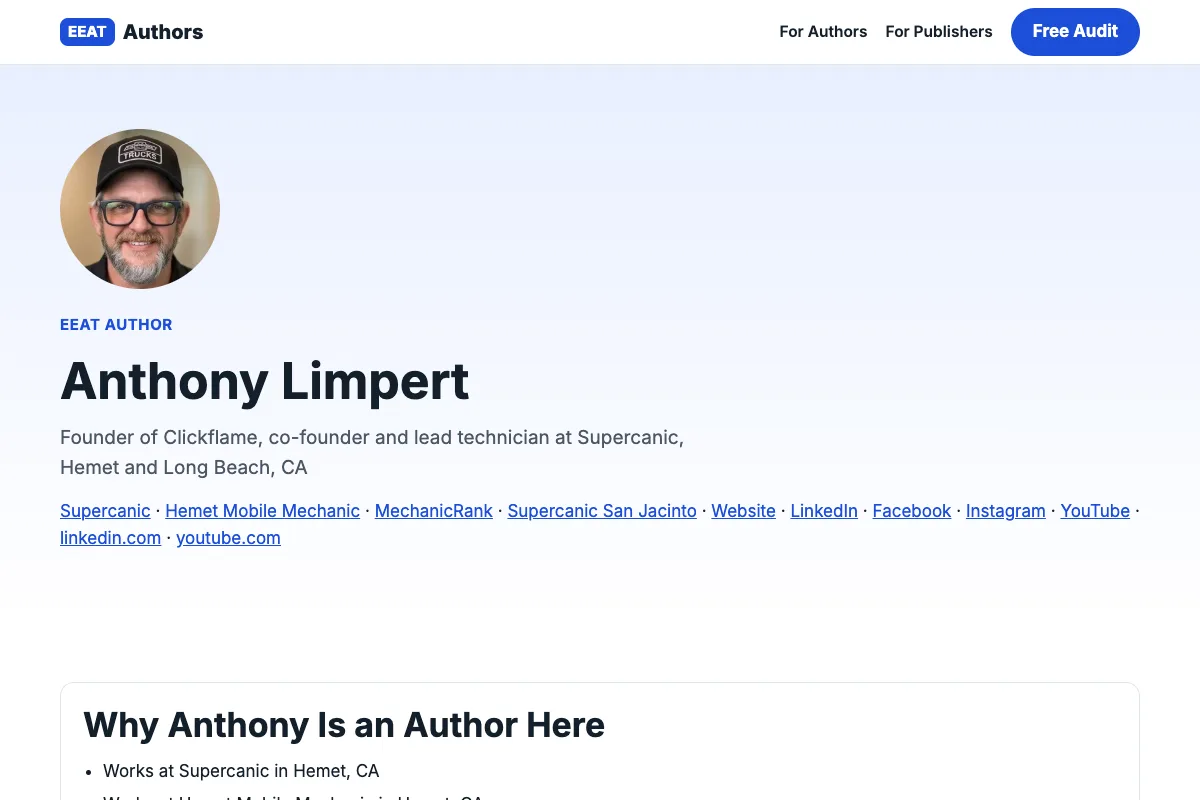
- Start from the expert. Their notes, their photos, their numbers from real jobs. That is the experience a model cannot supply.
- Let AI help write. Drafting, structure, cleanup. Google has no problem with that.
- Expert checks the facts. Google says to fact-check AI content by hand. The expert is the right person to do it.
- Label the role. Written by, or written with, or reviewed by. Accurate authorship is what Google's helpful content page asks for.
- Give the name somewhere to go. An author page with licenses and links, and Person schema pointing to it.
Can You Swap a Fake Author for a Real One?
Yes, and it is one of the most useful cleanups a site can do. Pick the real person who knows the topic. Have them read each post and fix what is wrong. Change the byline. Retire the fake profile. Do not keep the fake page around with a new name on it.
If no one inside the business can do it, that is what we built EEAT Authors for. Real experts join free and get readership. Site owners get a vetted expert in their field to review or write posts, with a real author page behind every byline.
The Short Version
- AI content is not penalized for being AI.
- Mass-produced, low effort pages are, AI or not.
- Fake authors and false credentials are on the rater guidelines' lowest list.
- A real expert, an honest label and an author page fix most of it.
Want to see where your own bylines stand? The free audit takes about 20 seconds.
Questions People Ask
Does Google penalize AI-generated content?
Not for being AI. Google says generative AI can be used for high or low quality content. Mass-produced pages that add no value can fall under its spam policies.
Can I use a fake author name on AI content?
No. Google's rater guidelines list AI content with made-up author profiles under the lowest rating.
Do I have to disclose AI use?
Google calls disclosures useful where readers might wonder how a page was made. It is advice, not a rule.
Should I fact-check AI content?
Yes. Google says it is critical to check AI content by hand before publishing, including titles and structured data.
Check Your Own Site
Our free audit reads your site and scores 14 trust signals out of 100, with a fix for each gap. No signup.
Where to Find Us
235 E Broadway #800, Long Beach, CA 90802